


What are washable incontinence pants?
Washable incontinence pants are knickers with a layered absorbent panel sewn into the gusset, so they catch urine leaks and can be laundered and reworn for a year or more. From the outside they look like ordinary underwear. Nothing is stuck in and there’s no adhesive strip to peel.
The panel does three jobs. A top fabric pulls liquid away from your skin, a middle section absorbs and holds it, and a backing resists leaks through to your clothes. The Bladder & Bowel Community describes the same family of products under several names: pants with a built-in pad, pouch pants that hold a separate pad, pull-ons and all-in-ones.
Annahitah’s Pro Flo pants sit in the built-in group. The site says they cater for “all leaks, including weak bladder and incontinence”, and the same pants are sold for periods, postpartum bleeding and sweat. There’s no separate “incontinence fabric”. It’s the same four-layer gusset doing a different job.
Who are washable incontinence pants for?
Washable pants are for people with light to moderate bladder leaks: the dribble when you cough, the few drops on the way to the toilet, the damp patch after a run. NHS Wirral’s continence service, the Bladder & Bowel Community and Brand A all place washables in that band, and NHS Wirral says heavier leaks may still need disposables.
That covers a lot of people. NHS England said in 2018 that bladder problems affect more than 14 million people in the UK. The British Association of Urological Surgeons puts urinary incontinence itself at more than 3 million, and adds that 60 to 80 per cent never seek advice. The Bladder & Bowel Community says around a third of UK women have some stress incontinence, though it doesn’t cite a source for that figure.
Annahitah describes its coverage as “from dribbles to heavier leaks”. It publishes no ml figure for urine, so treat that as a description of range, not a measurement.
Washables are the wrong first step if you’ve lost control of your bladder altogether, if leaks arrived suddenly, or if you’re emptying large volumes without warning. Those patterns need a GP and a continence assessment before you shop for anything.
How do washable incontinence pants hold urine without feeling wet?
The pants hold urine because the layer next to your skin wicks liquid downward into an absorbent core faster than it can pool on the surface, so the top stays dry to the touch. Annahitah’s FAQ puts it as an outside moisture-wicking layer with absorbent, breathable mid-layers underneath, four layers in total.
The site rates its pants by tampon equivalents rather than ml. Super Heavy styles hold 6 to 8 tampons’ worth of blood; Heavy and Medium styles 3 to 5 tampons’ worth per wear. No urine figure exists on the site.
One thing to know about any brand’s stated capacity: it’s a ceiling measured by soaking a sample in the lab, not what the gusset holds when you sit down hard on it.
Are incontinence pants different from period pants?
Yes, in how they’re rated, even when the fabric build is the same. Urine arrives in a fast, thin surge, while menstrual blood is thicker and arrives slowly, so a pant tested with blood or saline won’t automatically hold the same volume of urine. Brand A and Brand B both make this point, and Brand A advises against swapping its washable incontinence pants over to period use.
There’s independent support for being cautious: a 2023 study in BMJ Sexual & Reproductive Health tested period products with real blood and found period underwear held far less than its saline rating suggested. Ratings depend on what liquid was poured in.
Annahitah sells one range for both uses and labels it by absorbency level, so you pick the level for the leak you have. For bladder leaks the site gives no ml, only the “dribbles to heavier leaks” description, so knowing your leak pattern matters more than any number.
What type of bladder leak do you have, and why does it matter?
The NHS names five types of urinary incontinence, and the two you’ll meet most are stress (a small leak when pressure lands on your bladder from a cough, sneeze, laugh, lift or jump) and urge (a sudden, intense need to pass urine with the leak following seconds later). Mixed incontinence is both together. Overflow and total incontinence are rarer and need medical assessment rather than a product choice.
The type changes what you buy. Frequent small stress leaks suit a lighter everyday style you can wear all day, while occasional larger urge leaks may need a heavier style, because the volume lands in one go. Our stress versus urge guide goes through all five types.
When should you see a GP about bladder leaks?
The NHS says to see a GP if you have any type of urinary incontinence, and it describes the problem as common and treatable. Don’t wait until it’s “bad enough”.
Some signs mean you shouldn’t wait for a routine appointment at all. The NHS lists these separately, and they apply whatever pants you wear:
- Blood in your urine, even once, even a small amount, even if you’re not sure. Pink, red or dark brown urine means asking for an urgent GP appointment or calling NHS 111. It can be a sign of cancer, and it needs checking.
- Signs of a urinary tract infection: burning when you pee, needing to go more than usual, urine that’s cloudy or smells, pain low in your tummy or back, or a temperature. Women aged 16 to 64 can go to a pharmacist first. Ask for an urgent GP appointment or call 111 if you’re over 65, pregnant, diabetic, in pain, passing blood, not improving after 48 hours, or getting infections repeatedly (two in six months or three in a year).
- Leaking that’s new or suddenly worse in an older person. The NHS says this can itself be a sign of a UTI.
- Confusion or drowsiness alongside any of the above means 999 or A&E.
NICE adds prompts for specialist referral that your GP will know: persistent bladder or urethral pain, a bladder you can still feel after emptying, a lump in your pelvis, bowel leakage as well as bladder leakage, numbness or weakness that could point to a nerve condition, difficulty emptying, or past pelvic surgery or radiotherapy.
If any of that is you, go to the GP before you go shopping. Pants manage a leak. They don’t find out why it’s happening.

A fit for your flow.
Find your level of protection, then choose the shape that feels right for you.
Find your pair Explore styles, flow ratings & sizesWhat will the GP do, and what can the NHS give you for free?
The GP will start by asking about your symptoms, what you drink, how much caffeine and alcohol, and which medicines you take, then examine you and may ask you to keep a bladder diary for at least three days. The NHS diagnosis page describes a pelvic exam with a cough test, a urine dipstick if infection is suspected, and a scan for leftover urine if overflow is suspected. Scopes and pressure tests come later, and only if treatment fails.
From there, the GP can refer you to the local NHS continence service (some areas let you self-refer). It’s staffed by continence advisers and specialist physiotherapists. A continence nurse assesses you before anything is issued, and until that assessment you buy your own products.
Free products do exist, but the rules are local. Royal Berkshire’s leaflet describes the assessment first. Leicestershire’s draft guidance supplies pads only once other treatment has been tried and caps the daily amount. Age UK says plainly that NHS provision depends on local eligibility criteria.
Some services now issue washable underwear. NHS Wirral sends one trial pair, then four more as a yearly allocation, sized by hip measurement, for light to moderate leaks, and may point you to the WaterSure scheme if the extra washing pushes up a metered water bill. Ask your continence nurse what your area offers. The Bladder & Bowel Community’s advice is to be persistent and ask for a referral if you’re not getting anywhere.
Can pelvic floor exercises stop the leaks?
Yes, for stress and mixed leaks pelvic floor training is the first treatment NICE and the NHS recommend, and products come after it, not instead of it. NICE guideline NG123 says supervised pelvic floor muscle training for at least three months is first-line for stress or mixed incontinence. For urge or mixed incontinence it’s bladder training for at least six weeks.
The NHS treatment page gives the dose: at least eight squeezes, at least three times a day, for at least three months, and keep going if it’s helping. Its 10 tips page adds that benefits take months, so don’t judge it after a fortnight.
The Squeezy app was designed by NHS pelvic health physiotherapists and gives reminders, visual guides and a log you can share with a physio. It’s a paid app. The Bladder & Bowel Community says it was reviewed for clinical safety by the NHS apps library.
The other NHS tips are practical rather than medical: cut caffeine (coffee has the biggest effect), cut alcohol, drink six to eight glasses of water a day rather than restricting fluids, treat constipation, stop smoking, brace your pelvic floor before you lift, and swap high-impact exercise for Pilates-type work while the muscles strengthen. NICE also says HRT isn’t recommended as an incontinence treatment, and that medicines may take four weeks to show benefit.
Pants fit around that plan. NICE’s own wording is that absorbent products are a coping strategy while you wait for treatment, an adjunct to it, or a long-term option only after other routes have been explored, with a review at least once a year.
How do you choose the right absorbency and style for bladder leaks?
Choose by leak pattern first, then by cut, then by size. Annahitah grades its pants Light, Medium, Heavy and Super Heavy, and nine styles sit in its incontinence collection.

| Leak pattern | Annahitah level to look at | Styles in the incontinence collection | Cut and fabric |
|---|---|---|---|
| A few drops when you cough, sneeze or exercise | Light | Venus, Nirvana, Eden | Thongs and g-strings; organic cotton (Venus, Eden) or nylon blend (Nirvana) |
| Regular small leaks through the day | Heavy | Serendipity, Lilah | Brazilian brief in bamboo (Serendipity); lace high-waist brief in organic cotton (Lilah) |
| Larger or less predictable leaks, overnight cover | Super Heavy | Shanti, Odessa, Valentina, Athena | Seamless cut in high-waist and short styles (Shanti, Odessa); organic cotton brief (Valentina); lace brief (Athena) |
A few pointers from the catalogue:
- For the gym, the seamless thongs Nirvana and Venus are the ones the site calls invisible under tight gym clothes, and the site says Odessa is stylish enough to wear under tight clothes too.
- For tummy cover, the high-waist styles such as Shanti, Odessa, Lilah and Valentina sit higher on the waist.
- For odour control, six styles carry a silver-free antimicrobial finish: Shanti, Odessa, Athena, Valentina, Serendipity and Venus. The rest are left plain.
- For a teenager, Valentina is the only style sold in XXXS (UK 2-4) and is made from organic cotton.
If you want to start with one pair and learn your pattern, a Super Heavy style gives you the most absorbency to work with (the site describes its bladder-leak coverage as “from dribbles to heavier leaks”), and once you know what a typical day looks like, a mix of light and heavier washable incontinence pants will carry you through a week with a wash in the middle.
On size: measure your hips in centimetres and use the chart. Annahitah’s sizes run XXS (UK 4-6) to XXL (UK 16-18), the site says they’re on the generous side, and its own advice is “if in doubt, opt for the smaller size”.
How do you wash washable incontinence pants?
Rinse them in cold water as soon as you take them off, then machine wash on a gentle 30°C cycle with dark colours, using a gentle detergent, no fabric softener and no bleach, and hang them to dry. That’s Annahitah’s care routine, and the brand says softener and bleach interfere with the four-layer technology and absorbency. Low tumble is allowed if you must, but air drying gives the longest life, which the site puts at 18 months to 3 years.
The cold rinse matters because it gets the urine out of the fibres before it has time to develop a smell. Other brands vary on temperature (Brand A and Brand C say 40°C, Brand D and Brand E say 30°C), but all of them agree on no softener, no bleach and no high heat.
Do washable incontinence pants smell?
No, not if you change them when they’re wet and wash them properly, because the smell people fear comes from bacteria acting on urine over time, not from the pants themselves. Fresh urine has little odour. Left warm and damp for hours, it develops one. The fix is a spare pair, not a stronger perfume.
Annahitah’s antimicrobial styles add a “safe, fully tested and certified antimicrobial agent” for extra odour control, and the brand is clear that it contains no silver. The plain styles rely on the wicking layer and prompt changing alone. Both approaches work if you change when wet.
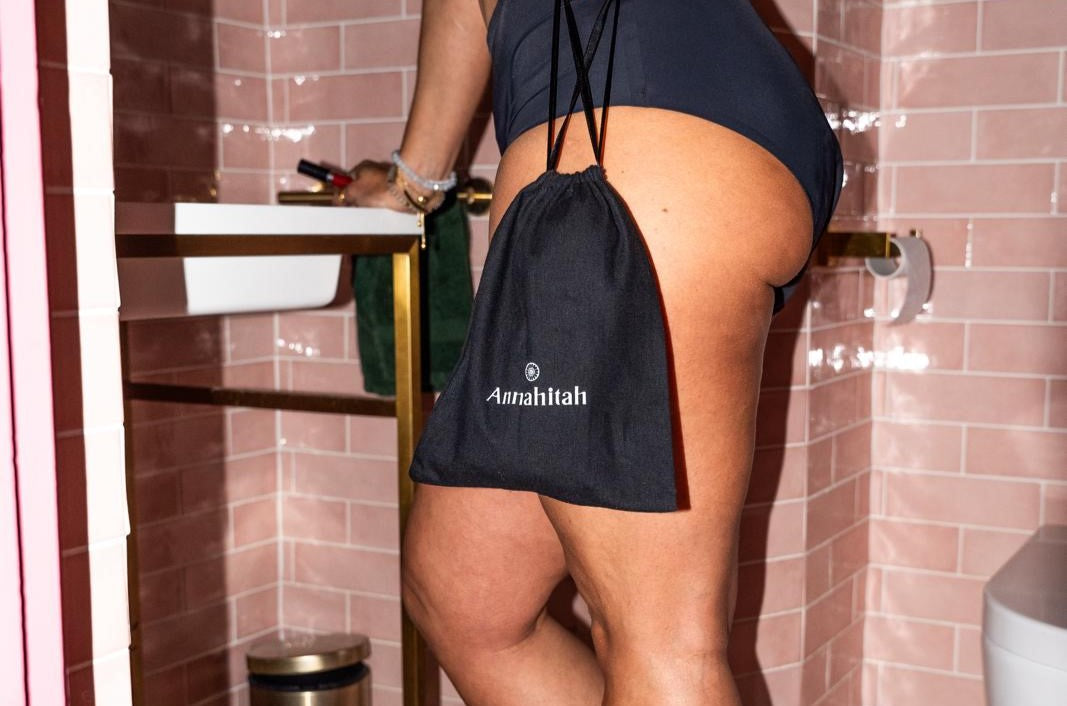
Every Annahitah order comes with a washable organic cotton drawstring Eco-bag, which is the practical answer for work: a dry pair in the bag going out, the used pair tucked in it coming home.
Are washable pants worth it for cost and waste?
Yes, for light to moderate leaks washables come out ahead on waste and, over a year or more, on cost, as long as you accept the laundry. The UK buys more than a billion incontinence products a year, and adult incontinence product use grew by about half in five years, according to a London Assembly report citing industry body EDANA. Policy Connect estimates that more than a million tonnes of absorbent hygiene products (nappies, period and incontinence products) are thrown away in the UK each year, mostly incinerated or landfilled.
A pair of pants worn and washed for 18 months to 3 years replaces a long run of single-use products. Set against that are a higher upfront cost, water and energy for washing, and the fact that washables hold less than the heaviest disposables, which still earn their place for heavy leaks, long nights and travel. The side-by-side on capacity, cost, skin and disposal is in our washable versus disposable comparison.