
What is a first period kit, and why make one early?
A first period kit is a small, ready-packed bag that means a first period is handled in minutes rather than panicked over, and the NHS timeline says most girls will need it within about two years of their breasts starting to develop. That’s the whole idea. Nobody can predict the day, so the kit sits in her bag and waits.
The NHS says most girls start around 12, anywhere from 8 to 17 is usual, and underarm and pubic hair come first. Annahitah’s Starter Set page adds that periods can begin earlier than many parents expect, sometimes as young as nine. A kit made at 10 might wait two years. That’s fine. A kit made the week after her period starts has missed its job.
A first period is often a reddish-brown stain rather than a flow, according to the NHS. So the kit doesn’t need to be big, it needs to be there.
What age should you give a first period kit?
Once puberty signs appear is early enough that the kit is ready without feeling alarming, and for many girls that’s somewhere between 9 and 11. The trigger is her body, not her birthday. Breast development is the clearest sign, because the NHS says the first period tends to follow about two years later.
Many girls also notice a clear or whitish discharge in their knickers for some months before a period arrives. That’s a normal part of puberty and a useful nudge to get the kit packed if it isn’t already.
Give it as a quiet, practical thing rather than a ceremony, unless she’d like one. Some girls want a box with a card. Others want it slipped into their school bag with a two-line explanation. Ask her which.
What goes in the school-bag kit?
One pair of period pants or two pads, spare dark knickers, a washable bag that closes, a few wipes and a note of who to ask at school. That’s the complete list. It fits in a pencil case and lives in the bottom of her bag all year.
| Item | Why it’s there | Notes |
|---|---|---|
| 1 pair of period pants (Heavy or Super Heavy) | Catches a first period on its own, nothing to position | Annahitah’s Super Heavy holds 6-8 tampons’ worth |
| 2 pads as backup | For a girl not yet wearing pants daily, or a heavier day | Pick a slim, wrapped one |
| Spare dark knickers | If it started before she put period pants on | Black hides everything |
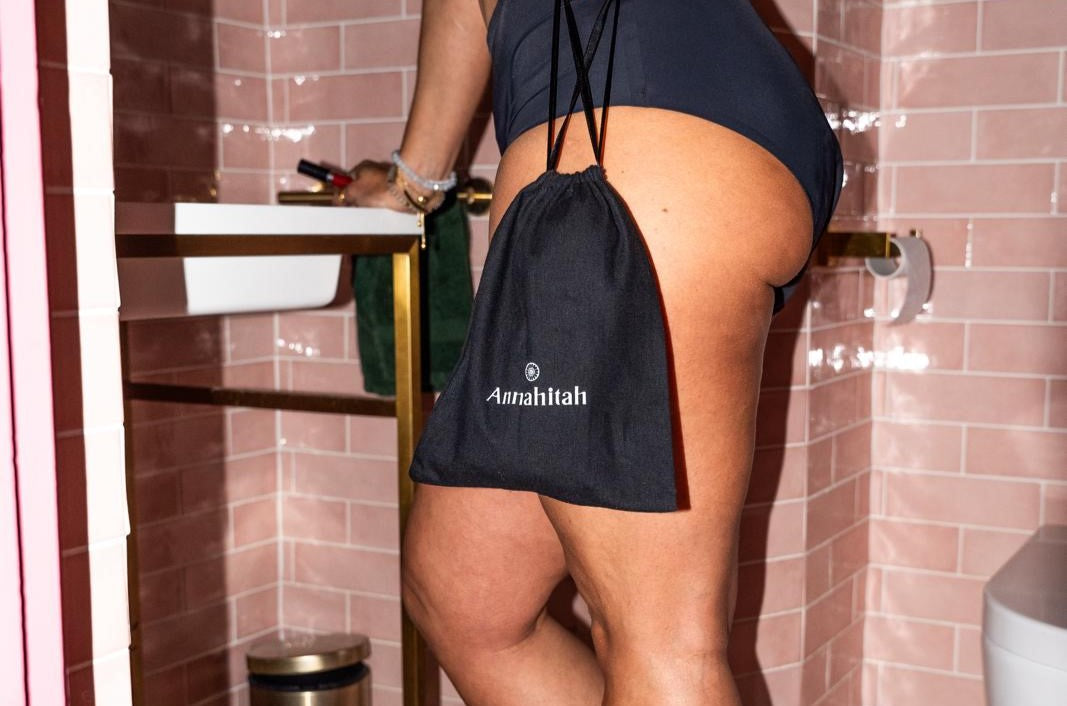
| Washable drawstring bag | Carries the spare, then the used pair, closed | Annahitah’s organic cotton Eco-bag comes with every order |
| 3-4 individually wrapped wipes | Clean-up in a cubicle | Unscented |
| Spare tights or dark leggings (optional) | If a stain reaches her uniform | Rolled small |
| A card with names | Who to tell: school nurse, form tutor, a friend | Written together, so she’s agreed it |
The NHS Wales children’s occupational therapy service gives much the same advice to parents: dark knickers, a small zip bag with spare knickers and a pad for school, and practising with a pad beforehand so the first real time isn’t the first time ever.
Keep the kit small. A bulging bag is one she takes out and leaves at home. Toilet passes, PE and the free products most UK schools now stock are covered in our school guide.
Which should go in the kit: period pants, pads or both?
Both, for the first year: period pants cover a light, surprise first period on their own, and a pad or two as backup helps a girl who isn’t yet sure of her flow. Period pants are knickers with an absorbent gusset built in. She wears them like ordinary pants, and if her period starts in double maths, it lands on the gusset and nobody knows.
For the kit itself, the question is whether she’ll wear period pants every day or only when she suspects something. A girl who wears them daily around the time she expects a period needs only a spare pair and a bag. A girl in ordinary knickers most days needs the spare knickers and a pad or two as well, because she can’t change into period pants she isn’t carrying.
Heavy or Super Heavy is the right absorbency for a first-period kit. The NHS says first periods are often light, but a first-year flow is unpredictable, and extra margin costs nothing. Annahitah’s Super Heavy styles hold 6 to 8 tampons’ worth of blood, and its Heavy and Medium styles 3 to 5 tampons’ worth per wear.
Tampons and menstrual cups can wait until she’s curious about them. The NHS lists period underwear and pads as options in their own right.
What goes in the at-home kit?
Three to five pairs of period pants, a hot water bottle, a few pads, dark pyjama bottoms, and a book or leaflet that explains what’s happening in plain words. The home kit is the one she’ll use most, so this is where the pairs go.
| Item | Why it’s there | Notes |
|---|---|---|
| 3-5 pairs of period pants | Covers a full cycle with washing in between | Annahitah’s guidance is 3-5 pairs per cycle |
| Hot water bottle or heat pad | Warmth helps period pain, says the NHS | A warm bath does the same |
| Pack of pads | Backup, and for a girl who wants to try both | |
| Dark pyjama bottoms | A Super Heavy pair plus dark pyjamas takes the worry out of nights | |
| Old dark towel | For the bed on heavy nights, or for after a bath | |
| A book or leaflet | So she can read it alone when she wants to | The NHS “starting periods” page is a good one to print |
| Paper diary or calendar | To spot the pattern over the first year | A mark on the day it starts is enough |
| Something just for her | Chocolate, a card, a bath bomb | Turns the kit into a welcome |
The pants are the backbone. Annahitah’s First Period Starter Set is three pairs chosen for exactly this: Valentina and Shanti in Super Heavy and Serendipity in Heavy, in one size from XXS to XXL. If you’d rather pick pairs one at a time, that works too, and only Valentina goes down to XXXS. For a ready-made home kit, the starter set is the simplest place to start. Measure her hips with a soft tape and match the number to the size chart before ordering.
Washing is the other thing she’ll need to know. Rinse the pair in cold water after wearing, then machine wash at 30°C with dark colours. No softener, no bleach. Hang to dry.

A fit for your flow.
Find your level of protection, then choose the shape that feels right for you.
Find your pair Explore styles, flow ratings & sizesWhat about painkillers for school?
Ask the school office before you pack any, because policies vary between schools and in most of them painkillers can’t go in her bag without a consent form first. The Department for Education publishes statutory guidance on supporting pupils with medical conditions, and each school builds its own medicines policy from it. In practice, most ask for written parental consent, and many prefer to give a single dose of paracetamol from their own stock at lunchtime rather than let pupils carry it. Somerset Council’s guidance notes that schools decide for themselves whether to give non-prescription medicines at all, so a two-minute phone call saves a confiscated packet.
At home, the NHS self-help list for period pain is paracetamol or ibuprofen, a heat pad or warm bath, and gentle exercise. If pain stops her doing her usual things, or it’s severe and painkillers haven’t helped, that’s a GP visit.
How should she track her period?
A paper diary or a mark on a calendar works at any age, and some period-tracking apps require a parent’s permission for under-16s, so start on paper. The NHS Wales children’s OT advice is a diary to help predict the next period, and that’s all she needs in the first year.
Tracking matters for a practical reason. The NHS says the first few periods can be irregular while the body finds its rhythm, so a girl who’s noted the start dates can see the pattern settling and knows roughly when to wear period pants “just in case”.
If she wants an app later, check its age terms. Some tracking apps, for example, require parental permission for users under 16. Until then, a pencil mark is private, free and enough.
What should she do if it starts at school?
Tell a trusted adult or friend, change into the spare pair from her kit, and remember a jumper tied round the waist hides a stain until she can sort it out. If she has no kit, the school can help. In England, state schools can order free pads, tampons, cups and period pants through the Department for Education’s scheme, and Scotland and Wales have their own free provision, so there’s almost always a product somewhere in the building.
Run through this once, together, before it happens: where the kit is, who she tells, and which toilets are nearest her form room. A girl who’s rehearsed the plan treats a first period at school as a nuisance rather than a disaster.
Tell her the truth about leaks, too. Most women have had one, nobody notices as much as she thinks, and a quiet “I need the toilet, it’s my period” is all a teacher needs to hear.
What about a sleepover or PE kit?
A sleepover kit is a Super Heavy pair for the night, a second pair for the morning, dark pyjama bottoms and the drawstring bag. Annahitah’s Super Heavy styles are designed for overnight wear, and its own advice for a heavy day is one pair through the day and a fresh Super Heavy pair for the night. An old dark towel under her on the first night away adds a layer of calm.

For PE, a Super Heavy pair under dark shorts does the work, and the seamless styles Shanti and Odessa sit flat under leggings. Period pants don’t work for swimming, though. Annahitah doesn’t make period swimwear yet, so a tampon when she’s ready for one, or sitting out her heaviest day, are the options.
How do you turn the kit into a gift rather than a drill?
Add one thing that’s only for her, such as chocolate, a card or a book she’d choose anyway, so the box feels like a welcome rather than a warning. Several brands sell first-period kits with exactly that thinking: Brand A includes chocolate in its starter kit, and Brand B’s packs include a book.
Let her be part of making it. Choosing the style of pants (Annahitah’s teenage range has six, all black, from plain organic cotton Valentina to lacy Athena), picking the bag, deciding what goes in the “just for me” corner. A kit she helped pack is a kit she knows the contents of.
Keep the tone matter-of-fact. The NHS suggests treating periods as an ongoing conversation rather than one big talk, using the proper words, and including brothers. The kit is a prop for that conversation, not a replacement for it.