




What if your monthly cycle isn't an inconvenient disruption to endure, but your body's most sophisticated internal compass? It's all too easy to feel entirely disconnected when sudden energy slumps, mysterious mood shifts, and confusing cycle day counts leave you blindsided by your own biology. Too often, uncomfortable pre-menstrual tension arrives without warning or context, making the underlying period cycle stages feel like an unpredictable mystery rather than an intelligent natural rhythm.
You deserve to live in deep harmony with your physical self, free from second-guessing your calendar. When you discover the biological blueprint of your four period cycle stages, you gain the confidence to navigate each phase with genuine ease and self-honouring grace. Ahead, we explore the physiological triggers behind every shift, delivering a clear framework to predict your energy, decipher your bodily signals, and support your flow every single day of the month.
Key Takeaways
- Understand the distinct biological markers that govern the four continuous period cycle stages, starting from the very first drop of menstrual fluid.
- Uncover how natural hormonal shifts between follicle-stimulating hormone, oestrogen, and progesterone influence daily vitality and mental clarity.
- Demystify the brief ovulatory window to accurately identify peak fertility cues and decipher pre-menstrual physical signals without guesswork.
- Embrace intuitive symptom-led cycle syncing, tailoring nourishing whole foods and restorative movement to honour your changing energy thresholds.
- Transform monthly self-care by pairing natural cycle tracking with breathable, reusable protection designed for complete physical peace of mind.
What Are the Four Period Cycle Stages? The Biological Blueprint
Your body does not exist in a stagnant state. Instead, it operates across a perpetual, rhythmic endocrine continuum. Far from being an isolated monthly event, menstruation is simply the opening act of an intricate four-phase hormonal feedback loop. Governed by the communication pathway between your hypothalamus, pituitary gland, and ovaries (the HPO axis), your hormones rise and recede in deliberate waves. Day one begins decisively with the first unmistakable red sign of menses, setting off a coordinated biological cascade that renews your uterine landscape every month.
Grasping the four biological phases of the menstrual cycle allows you to replace guesswork with physical authority. Rather than viewing your body as unpredictable, you begin to recognise the elegant cadence shaping your emotional landscape, physical resilience, and restorative needs.
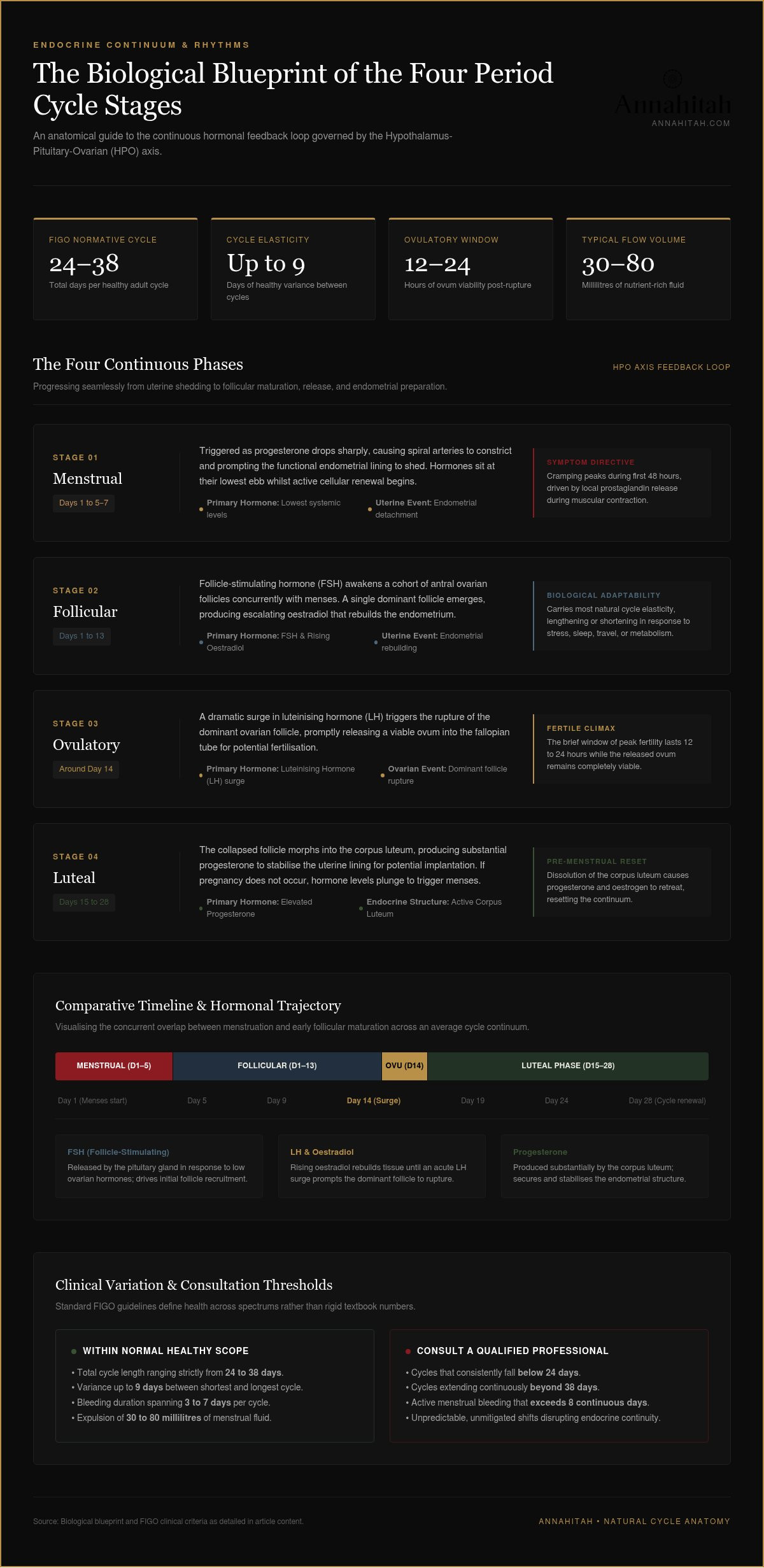
The Four Distinct Phases at a Glance
The four period cycle stages progress seamlessly from shedding to maturation, release, and preparation:
- Menstrual Phase (Days 1–5 to 7): Progesterone drops sharply, prompting the functional endometrial lining to shed alongside blood and fluid.
- Follicular Phase (Days 1–13): Overlapping with menses, follicle-stimulating hormone (FSH) prompts ovarian follicles to grow, driving rising oestradiol that rebuilds the endometrium.
- Ovulatory Phase (Around Day 14): A dramatic surge in luteinising hormone (LH) triggers the rupture of the dominant follicle, releasing a viable ovum into the fallopian tube for a brief 12-to-24-hour window.
- Luteal Phase (Days 15–28): The collapsed follicle becomes the corpus luteum, producing substantial progesterone to stabilize the uterine lining for potential implantation.
Debunking the Strict 28-Day Myth
Textbook diagrams love the clean precision of a 28-day schedule. Real life is rarely so rigid. Under standard criteria defined by the International Federation of Gynecology and Obstetrics (FIGO), a normal adult cycle regularly spans 24 to 38 days. Variation of up to nine days between your shortest and longest cycles remains entirely healthy.
The follicular phase carries most of this natural elasticity, lengthening or shortening based on stress, international travel, disrupted sleep, or metabolic shifts. Your body senses its environment and adapts. However, if your cycle consistently falls below 24 days, extends beyond 38 days, or bleeding exceeds eight days, it's prudent to consult a qualified healthcare professional to rule out underlying imbalances.
The Early Cycle: Navigating Menstruation and the Follicular Rise
Every cycle begins with a biological release. When pregnancy has not occurred, the corpus luteum dissolves, causing progesterone and oestrogen levels to plunge. This sudden hormonal retreat signals the spiral arteries of the uterus to constrict, prompting the functional endometrial layer to detach. Bleeding begins. Far from being a standalone event, this shedding initiates the first of your interconnected period cycle stages, quietly resetting your endocrine balance for the month ahead.
While the uterus clears its internal landscape, an entirely new reproductive narrative unfolds within the ovaries. As outlined by the Office on Women's Health regarding the typical menstrual cycle timeline and hormonal shifts, the pituitary gland responds to low circulating ovarian hormones by releasing follicle-stimulating hormone (FSH). This rise occurs concurrently with active menses, proving that renewal and preparation are never mutually exclusive.
Stage One: The Menstrual Phase (Days 1–5)
Hormones sit at their lowest ebb. For three to seven days, your body expels 30 to 80 millilitres of menstrual fluid, a nutrient-dense blend of blood, cervical mucus, and tissue. Uterine cramping often peaks during the first 48 hours, driven by local prostaglandin production as muscle fibres contract to expel the lining.
Fatigue is not weakness here; it's a metabolic directive. Lower core energy invites you to soften your expectations and lean into intentional physical comfort. Many women find that pairing this vulnerable window with breathable, leak-proof protection, such as high-absorbency period pants like Shanti, provides the tactile ease and organic softness needed to rest without anxiety.
Stage Two: The Follicular Phase (Days 1–13)
Renewal takes hold. FSH awakens a cohort of antral ovarian follicles, each encasing an immature oocyte. Gradually, a single dominant follicle emerges, producing escalating amounts of oestradiol. This surge in oestrogen transforms your physiology in profound ways:
- Endometrial Proliferation: Oestrogen stimulates rapid cellular division, thickening the uterine lining from a thin baseline of 2–4 mm up to a lush 8–12 mm rich in blood vessels.
- Cognitive Vitality: Rising oestradiol enhances dopamine and serotonin receptor sensitivity, frequently clearing mental fog and elevating verbal fluency.
- Sustained Physical Stamina: Glycogen sparing improves, which often translates into lighter, more buoyant physical energy and quicker muscular recovery.
By day ten or eleven, the contrast with your bleeding days is stark. Your skin appears more radiant, social confidence naturally peaks, and mental clarity returns. Your biology is gathering strength for ovulation.
The Mid-to-Late Cycle: Ovulation, the Luteal Shift, and PMS
Midway through your monthly journey, hormonal communication reaches its crescendo. Ovulation marks the biological dividing line between the dynamic creation of the follicular phase and the reflective grounding of the luteal stage. Far from a passive event, this transition demands notable systemic coordination. Understanding these latter period cycle stages provides invaluable clarity on why your body suddenly shifts from high-wattage outward vitality to quiet inward preservation.
Listening to these mid-cycle nuances removes the temptation to pathologise regular bodily signals. Clinical resources from the Cleveland Clinic highlighting adapting movement and nutrition to your cycle stress that synchronising your lifestyle with these shifts begins with recognising how your core temperature, metabolic pace, and physical discharge change in lockstep.
Stage Three: The Ovulatory Phase (Days 14–16)
A peak in oestradiol prompts the pituitary gland to release a sharp surge of luteinising hormone (LH). Within 24 to 36 hours of this surge, the dominant Graafian follicle ruptures, releasing an oocyte into the fallopian tube. The egg's lifespan is remarkably brief, remaining viable for only 12 to 24 hours. The fertile window itself covers roughly six days, because fertile cervical mucus can sustain sperm for up to five days prior to release.
Your body offers distinct physical cues during this surge:
- Clear, Stretchy Mucus: Estrogen triggers abundant, raw-egg-white cervical fluid to facilitate sperm mobility.
- Elevated Libido: A subtle peak in free testosterone amplifies desire, confidence, and sensory awareness.
- Unilateral Pelvic Sensation: Roughly one in five women detects mittelschmerz, a mild, momentary twinge on one side as the follicle expands and releases.
Stage Four: The Luteal Phase (Days 15–28)
Once empty, the collapsed follicle undergoes a stunning metamorphosis, transforming into a temporary endocrine organ called the corpus luteum. It secretes rich quantities of progesterone. Progesterone acts as a biological stabiliser. It transforms the endometrial lining into a spongy, secretory bed, elevates resting basal body temperature by 0.3°C to 0.5°C, and stimulates GABA receptors in the brain to encourage deep calm.
Progesterone also slows smooth muscle contractions, occasionally causing digestive sluggishness or mild fluid retention. By late luteal phase, roughly 70% to 90% of women report common pre-menstrual physical sensations, such as breast tenderness, food cravings, or lower energy. When implantation does not happen, the corpus luteum disintegrates into scar tissue (the corpus albicans). Progesterone and oestrogen drop sharply, initiating the next menstrual bleed. While natural mood dips are common, severe emotional distress may indicate Premenstrual Dysphoric Disorder (PMDD), which affects 3% to 8% of women and requires compassionate medical evaluation.
Cycle Syncing Guide: Optimising Movement, Nutrition, and Rest
Rigid daily routines ignore female physiology. Your metabolic pace, insulin sensitivity, and neuromuscular recovery shift as you journey across the four period cycle stages. Systematic reviews in sports science, including meta-analyses in Sports Medicine, show that group-level hormonal impacts on raw strength are statistically small. Rather than enforcing an inflexible rulebook, cycle syncing works best as symptom-led autoregulation: tuning your daily output to match your internal reserve.
Working with your biological blueprint allows you to build an intuitive, sustainable rhythm. Step into each transition deliberately:
- Menstruation (Days 1–5): Scale back intensity. Prioritise restorative movement like Yin yoga or unhurried walks, and replenish red blood cell production with bioavailable iron, zinc, and warm bone broths.
- Follicular Surge (Days 6–13): Capitalise on rising oestrogen. Channel this energetic window into complex creative tasks, high-intensity intervals, and progressive resistance training.
- Ovulatory Window (Days 14–16): Harness peak confidence. This brief surge is ideal for collaborative presentations, public speaking, or testing strength personal records.
- Luteal Preservation (Days 17–28): Pivot to steady-state conditioning and grounding meals rich in magnesium and unrefined complex carbohydrates. Protect your evening wind-down rituals fiercely.
Matching Exercise Intensity to Hormonal Fluctuations
Your physical capacity mirrors your systemic state. During the early follicular phase, enhanced insulin sensitivity allows your muscles to access fuel efficiently, making it the perfect phase for challenging workouts. Mid-cycle testosterone gives you an extra edge in power output.
The luteal shift brings elevated resting body temperature and increased protein breakdown. Workouts feel heavier; cardiovascular drift occurs faster under heat. Swap relentless endurance sessions for moderate strength training, pilates, or hikes. Listen to your body rather than forcing standard metrics.
Nourishing Your Metabolism Throughout the Month
Fuel demands evolve across every phase. Resting metabolic rate rises subtly during the luteal phase, driving genuine physiological cravings. Nourish this window with roasted root vegetables, quinoa, and dark chocolate to support serotonin production without steep glucose spikes. During ovulation, cruciferous vegetables provide indole-3-carbinol, supporting liver clearance of metabolised oestrogen.
True cyclical living blends internal awareness with sensory ease. For complete peace of mind through every bleed and flow transition, explore Annahitah reusable period underwear to find leak-proof, breathable comfort that honours your natural pace.
Honouring Your Natural Rhythms: Comfort, Care, and Intuitive Protection
Your menstrual cycle is an internal metric of vitality; medical professionals often refer to it as the body's fifth vital sign. When you view your cycle through this lens, monthly bleeding ceases to be an inconvenience to endure and becomes an instructive reflection of your overall wellbeing. Tuning in through daily journal notes, continuous basal body temperature sensors, or dedicated mobile tracking tools transforms abstract hormone data into actionable self-knowledge. This deliberate awareness lets you meet the continuous transitions of your period cycle stages with reverence rather than resistance.
Shedding the expectation of constant, linear productivity creates space for true restorative care. External pressures often urge us to ignore physical signals, but honouring your biology means matching your external routine to your internal state.
Cultivating a Mindful Menstrual Ritual
Creating comfort begins with redefining the bleeding phase as an intentional retreat. Soft lighting, botanical teas, and targeted heat therapy can work wonders, relaxing pelvic muscles to ease prostaglandin-induced cramping naturally.
Listen closely to fatigue cues without guilt. If your calendar permits, clear evening commitments during heavy bleeding days and give your body permission to slow down. True resilience comes from knowing when to pull back.
The Role of Luxurious, Sustainable Period Wear
Physical ease during menses relies heavily on the textiles resting against your skin. Conventional single-use options frequently rely on synthetic plastics, artificial fragrances, and chemical treatments that can irritate delicate vulval tissue. Embracing sustainable period underwear UK offers a gentler, zero-waste alternative that respects your natural skin barrier.
Understanding how do period pants work demystifies modern multi-layer absorbency. Rather than trapping moisture against sensitive tissue, high-performance designs use breathable, silky organic fabrics that wick fluid away, lock it securely within an absorbent core, and provide dependable leak-proof protection. By selecting thoughtful solutions tailored to your unique flow, such as The Starter Set or The Changing Tides, you turn practical period care into an empowering ritual of bodily ease.
Reclaiming Harmony Across Every Phase
Your biology holds profound wisdom. Embracing the four period cycle stages allows you to replace monthly dread with intuitive confidence. By recognising the interplay of rising oestrogen, mid-cycle peaks, and the restorative luteal shift, you can work alongside your body rather than constantly fighting against its natural tide. Living cyclically transforms self-care from an occasional indulgence into a daily, grounding practice.
True physical serenity begins with protection you can trust unconditionally. When you are ready to elevate your routine, explore Annahitah’s luxury period underwear. Crafted from silky, breathable organic textiles with multi-layer leak-proof performance, each tailored silhouette delivers effortless security from your heaviest flow days down to the gentlest spotting. Step into every phase knowing your body is supported, honoured, and celebrated.
Frequently Asked Questions
How many days does each stage of the menstrual cycle typically last?
Each phase follows a distinct physiological timeline. Menstruation generally lasts between three and seven days. The follicular phase spans roughly 14 to 21 days, representing the most variable window. Ovulation occurs swiftly over 24 to 36 hours following a luteinising hormone surge, while the subsequent luteal phase remains relatively consistent at 12 to 14 days. Altogether, these period cycle stages create a healthy total cycle of 24 to 38 days.
Can you become pregnant during every phase of your menstrual cycle?
Conception can only occur during your fertile window. This distinct six-day span comprises the five days preceding ovulation plus the day of release itself. Outside this window, an unfertilised egg survives merely 12 to 24 hours before dissolving. However, because sperm can remain viable in fertile cervical mucus for up to five days, intercourse taking place during the late follicular phase can lead to pregnancy once the egg arrives.
Why do energy levels drop significantly just before menstruation begins?
Late luteal fatigue stems from a sharp hormonal retreat. When implantation does not take place, the corpus luteum breaks down, causing both oestrogen and progesterone to plunge rapidly. This steep hormonal decline impacts brain neurotransmitters, lowering serotonin levels and disrupting sleep quality. Your resting metabolic rate also rises slightly during this phase, meaning your body burns through caloric reserves faster and naturally demands deeper rest.
What is the difference between the follicular phase and the luteal phase?
The primary difference lies in the dominant hormone and biological objective. The follicular phase is driven by follicle-stimulating hormone and rising oestrogen, focusing on maturing an egg and rebuilding the uterine lining. The luteal phase begins post-ovulation under the control of progesterone. It prioritises stabilising the endometrium, raising basal body temperature, and preparing the body for prospective implantation rather than tissue proliferation.
Is it normal to experience light spotting during ovulation?
Mild mid-cycle spotting is entirely normal for many women. The sudden, temporary drop in oestrogen right after the luteinising hormone peak can trigger minor destabilisation in the endometrium before progesterone rises to secure it. This brief spotting usually lasts one to two days, presenting as faint pink or light brown fluid mixed with fertile cervical mucus. Wearing light, breathable period thongs provides discreet comfort during these brief transitions.
How does chronic stress disrupt the delicate timing of cycle stages?
Elevated stress floods your system with cortisol and corticotropin-releasing hormone, which inhibits the hypothalamic release of gonadotropin-releasing hormone. This suppression stalls the pituitary signal to produce luteinising hormone and follicle-stimulating hormone. Consequently, follicular development halts, delaying or completely suppressing ovulation. This disruption lengthens the early period cycle stages, resulting in delayed menstruation, irregular bleeding intervals, or missed cycles altogether.
What bodily signs indicate that you have entered your fertile window?
Your cervix provides clear somatic cues as fertility approaches. Rising oestrogen prompts cervical fluid to shift from thick or creamy to clear, slippery, and stretchy, resembling raw egg whites. The cervix itself softens, opens slightly, and rises higher in the vaginal canal. Many women also notice heightened sensory awareness, increased sexual desire, and a brief unilateral twinge in the lower abdomen as the ovarian follicle prepares to release.